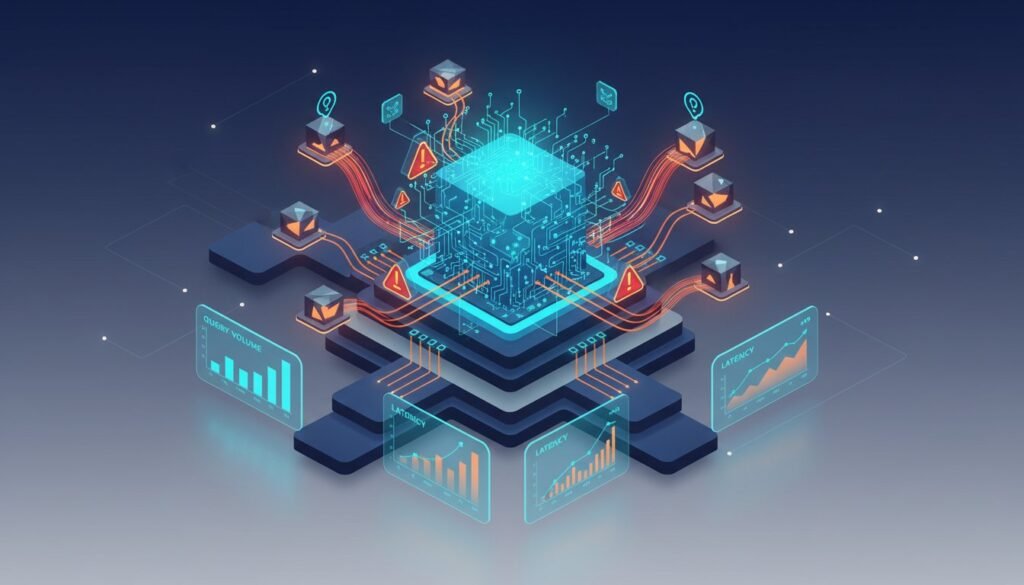
As autonomous agents transition from single-turn chat tools into complex multi-step reasoning systems, static prompt context windows are no longer sufficient. In 2026, building scalable enterprise RAG for AI agents requires hybrid vector-graph search architectures, dynamic semantic caching, and real-time context management to ensure high accuracy without skyrocketing token costs.
Implementing modern enterprise RAG for AI agents solves critical memory persistence and retrieval challenges. Traditional Retrieval-Augmented Generation relies on simple top-k similarity searches, which often fail when autonomous workers require cross-domain enterprise knowledge or long-term operational memory to complete multi-step tasks.
To achieve sub-second response times and prevent context window degradation, engineering teams must deploy multi-layered context routers. By combining dense vector embeddings with structured knowledge graphs, enterprise platforms can supply autonomous agents with precise, real-time ground truth while maintaining strict role-based data isolation.
Retrieval Performance Benchmark: Integrating GraphRAG (Knowledge Graph RAG) with hybrid semantic vector caches reduces multi-step agent hallucination rates by up to 64% in large enterprise knowledge bases.
Core Pillars of Enterprise RAG for AI Agents
Standard document search pipelines index static text files for human consumption. In contrast, enterprise RAG for AI agents must serve non-deterministic model execution pipelines, supplying contextual memory across execution loops without polluting the LLM’s active reasoning context.
To maintain high accuracy across complex workflows, context architectures rely on three foundational technical layers:
- Episodic vs. Semantic Memory Partitioning: Separating short-term execution logs (episodic) from global enterprise domain facts (semantic) prevents reasoning drift during long agent execution tasks.
- Hierarchical Document Chunking: Indexing data using multi-scale semantic chunks guarantees both broad high-level summary awareness and pinpoint technical specificity.
- Role-Based Access Control (RBAC) at the Index Level: Enforcing strict metadata filtering on every vector query prevents agents from leaking restricted internal documents across organizational boundaries.
To understand how context pipelines connect with runtime security, user interfaces, and cloud orchestration, explore our dedicated technical guides on AI Agent Governance and Security, Enterprise UI UX for AI Agents, Autonomous AI Infrastructure in 2026, Agentic AI Workflows, and Multi-Agent AI Systems Enterprise Architecture. For benchmarking vector database performance, consult the VLDB Endowment Database Research Archive.
Scale Your Enterprise Knowledge Engine with Devanum
Our AI system architects build custom hybrid vector-graph RAG infrastructure tailored for zero-hallucination agent deployments.
5 Best Context Strategies for Enterprise AI Agents
Optimizing context delivery for high-autonomy worker networks requires active context management. Deploy these five best context strategies when engineering your enterprise RAG for AI agents:
- 1. Hybrid Vector-Sparse Keyword Retrieval: Combine dense semantic vector search (e.g., HNSW) with sparse lexical algorithms (BM25) to catch both high-level context and specific technical IDs.
- 2. Dynamic Re-Ranking Proxy Pipelines: Filter initial search results through dedicated re-ranking models (e.g., Cohere Rerank) to trim irrelevant chunks before injecting payloads into prompt contexts.
- 3. Knowledge Graph Entity Linking (GraphRAG): Map relationships between enterprise entities in a graph database to give agents clear relational context across complex documentation.
- 4. Automated Context Compression & Summarization: Continuously condense long execution history threads into compact summary tokens to prevent context window saturation.
- 5. Real-Time Vector Index Synchronization: Utilize streaming CDC (Change Data Capture) pipelines to keep vector databases synchronized with live database changes in real time.
RAG Best Practice: Always attach strict source-attribution metadata tags to retrieved context chunks, allowing agents to provide verifiable, clickable citation links for every generated answer.
Comparing Standard Document RAG vs. Enterprise Agent Context Pipelines
Evaluating how traditional retrieval mechanisms differ from autonomous agent memory architectures is essential for data engineering teams:
| Architecture Dimension | Legacy Document RAG | Enterprise RAG for AI Agents |
|---|---|---|
| Query Type | Single-turn user search queries | Multi-step dynamic tool requests & autonomous reasoning steps |
| Data Structures | Unstructured text PDF/DOCX chunks | Hybrid vectors, knowledge graphs, & key-value execution stores |
| Memory Horizon | Stateless (forgotten after single query) | Stateful (episodic long-term memory & task history) |
| Latency Requirement | Batch or multi-second search tolerance | Sub-millisecond semantic cache lookups for real-time tool loops |
Eliminating Hallucinations with Self-Correction RAG Loops
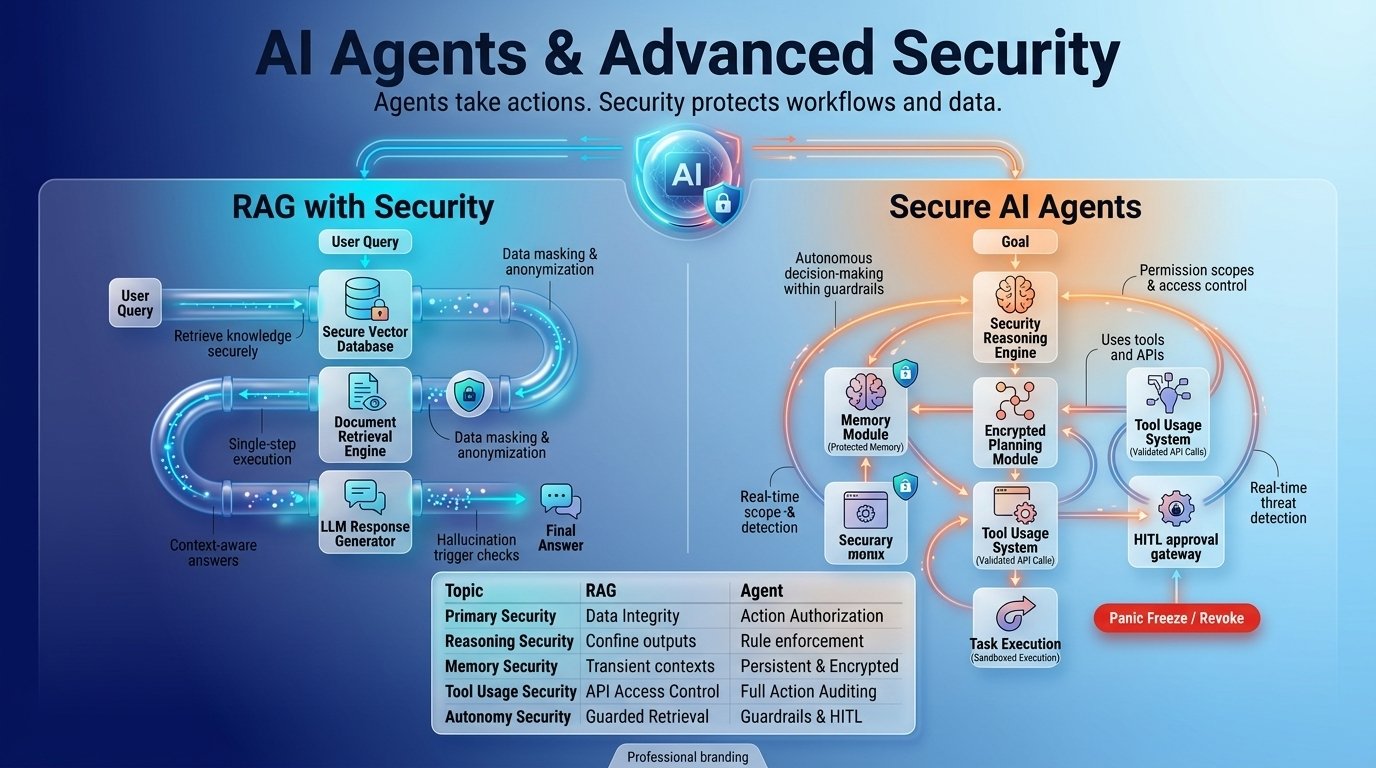
Even high-performance vector databases can return low-relevance context when processing vague agent goals. To prevent hallucinated responses from reaching production downstream systems, modern enterprise RAG for AI agents integrates Corrective RAG (CRAG) mechanisms.
When an agent retrieves context chunks, a lightweight evaluation node scores the relevance of the retrieved data. If relevance falls below a predetermined confidence threshold, the system triggers a web search fallback or prompts the human operator for clarification before continuing execution.
By embedding these self-correction guardrails into the context engine, organizations eliminate dangerous error propagation across automated multi-agent pipelines.
Future-Proofing Agent Memory Architectures
As context window lengths continue to expand across modern foundation models, the core challenge shifts from raw capacity to context quality and retrieval precision. Implementing robust enterprise RAG for AI agents guarantees your AI ecosystem maintains fast, verifiable, and secure memory operations as agent fleets scale across your global organization.