Deploying robust multi-agent orchestration protocols has become the foundational operational requirement for enterprise AI engineering in 2026. As organizations transition from single-prompt interactions to complex autonomous worker fleets, standardizing inter-agent communication channels is necessary to prevent state drift, eliminate execution bottlenecks, and maintain total system governance across distributed networks.
Implementing formal multi-agent orchestration protocols enables heterogeneous AI models to delegate tasks, negotiate capabilities, and share persistent context deterministically. Rather than relying on fragile custom REST interfaces or continuous prompt chaining, modern enterprise platforms rely on standard message specifications that treat autonomous agents as modular, policy-bounded cloud microservices.
Enterprise Performance Metric: Organizations deploying event-driven multi-agent orchestration protocols report a 52% reduction in inter-agent messaging latency and a 41% decrease in task execution failures across multi-cloud environments.
Architectural Pillars of Enterprise Multi-Agent Orchestration Protocols
Traditional microservice mesh protocols focus primarily on structural payload exchange. In contrast, comprehensive multi-agent orchestration protocols must govern dynamic reasoning state transitions, non-deterministic decision loops, tool authorizations, and contextual long-term memory access.
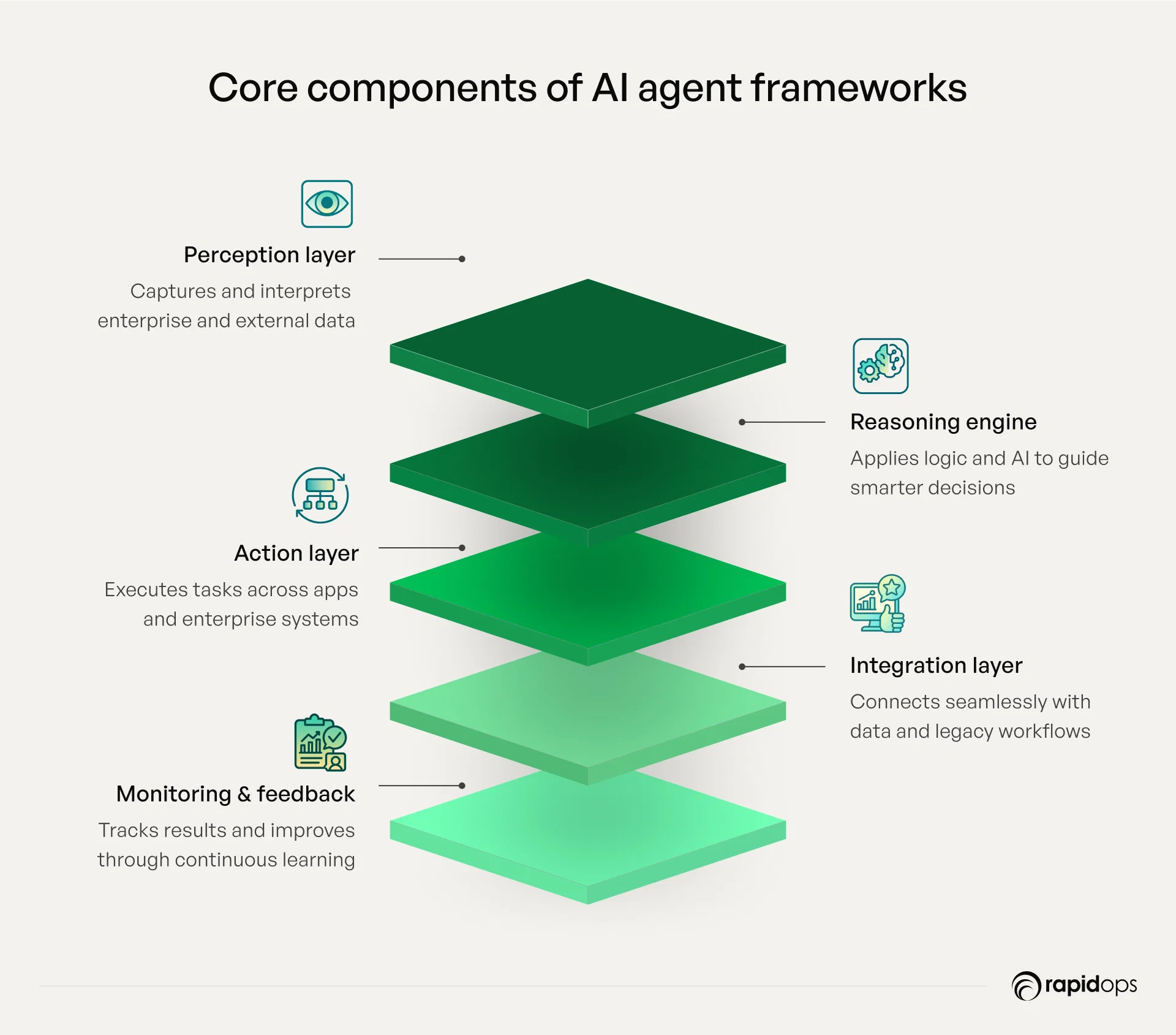
Production-grade architectures leverage four structural pillars to maintain systemic reliability:
- Stateful Global Execution Bus: Maintains active multi-agent conversation history, intermediate tool-call outputs, and goal progress without overloading single context windows.
- Dynamic Capability & Service Discovery: Allows master orchestrator nodes to inspect active agent registries, dynamically assigning sub-tasks based on current load, specialized skill sets, and token cost economics.
- Deterministic Consensus Protocols: Enforces automated voting mechanics, verification routines, or arbitrator agents when worker nodes return conflicting analytical outputs.
- Inter-Agent Security & Boundary Controls: Enforces granular zero-trust execution policies, ensuring downstream workers cannot access unauthorized APIs or breach compliance boundaries.
To see how orchestration protocols integrate across the full software stack, read our detailed technical blueprints on Enterprise RAG Architecture for AI Agents, AI Agent Governance and Security, Enterprise UI/UX for AI Agents, Autonomous AI Infrastructure in 2026, and Multi-Agent AI Systems Enterprise Architecture. You can also explore open community standards on the Model Context Protocol Open Specification.
Scale Enterprise Agents with Devanum Engineering
Our systems architects design resilient multi-agent orchestration protocols, state engines, and secure microservice layers customized for enterprise workloads.
Schedule Architecture Review →Top 5 Framework Standards for Multi-Agent Orchestration Protocols
Selecting the optimal standard depends on system requirements such as task complexity, state persistence, and latency bounds. Here are the five leading standards for implementing multi-agent orchestration protocols in modern systems:
1. Model Context Protocol (MCP) Standard
The Model Context Protocol establishes an open, client-server standard for connecting autonomous models to local datasets, security contexts, dynamic tool repositories, and unified prompt primitives. By standardizing the interface between the core reasoning engine and background tools, MCP eliminates custom glue code across complex multi-tier pipelines.
2. State Graph Topologies (LangGraph Framework)
Cyclic graph models represent agent workflows as stateful networks. Unlike linear chains, graph topologies allow workers to loop continuously, run isolated validation passes, attempt automatic error recovery, and support human-in-the-loop interventions without losing global execution state.
3. Conversational Peer-Review Networks (AutoGEN)
Conversational frameworks structure agent interaction through standardized dialogue loops. By enabling autonomous multi-party conversations, specialized roles (such as planner, developer, security auditor, and tester) can iterate on outputs, inspect code snippets, and converge on accurate responses without human oversight.
4. Role-Driven Sequential Pipelines (CrewAI)
Role-based protocols structure teams of agents into clear hierarchies. Each worker operates with specific domain capabilities, persistent memory stores, and explicit task boundaries. Task handoffs follow strict structural contracts, minimizing context noise during high-throughput enterprise execution.
5. Asynchronous Event-Driven Messaging (Kafka / NATS)
Enterprise systems with ultra-low latency demands rely on pub/sub event channels to route agent messages. Decoupling agent communication through high-speed brokers allows autonomous nodes to consume tasks asynchronously, scale out parallel workers instantly, and build resilient long-running background processes.
Architectural Comparison: Legacy Chaining vs. Modern Protocols
Evaluating structural differences between legacy prompt sequences and standardized multi-agent orchestration protocols highlights key trade-offs in enterprise scalability:
| System Metric | Legacy Monolithic Prompt Chaining | Modern Multi-Agent Orchestration Protocols |
|---|---|---|
| State Context | Single growing context window vulnerable to truncation | Isolated sub-agent context pools with central state routing |
| Fault Management | Single node error crashes the entire execution pipeline | Independent worker retries, automatic failovers, & supervisor intervention |
| Extensibility | Brittle custom integrations requiring frequent refactoring | Standardized schemas allowing plug-and-play agent integration |
| Parallel Processing | Synchronous execution bounded by model speed | Asynchronous parallel execution across multi-core compute nodes |
| Governance Control | Opaque internal logic with limited intermediate audit trails | Granular per-agent telemetry, message logging, & RBAC enforcement |

Preventing Deadlocks in Multi-Agent Orchestration Protocols
When autonomous workers iterate on shared tasks, circular dependency risks emerge. For instance, a software generator agent might stall while awaiting continuous clarification from an automated testing node that is simultaneously waiting for schema validation.
To address execution deadlocks, production multi-agent orchestration protocols embed deterministic circuit breakers. Independent supervisor processes monitor message exchange frequency, token consumption velocity, and state deltas:
- Time-To-Live (TTL) Controls: Attaching strict hop limits to every inter-agent request packet to prevent infinite forwarding loops.
- State Delta Validation: Tracking global execution metrics; if successive agent loops fail to advance task completion, the supervisor pauses execution.
- Automated Rollback & Escalation: Triggering automatic checkpoint rollbacks to restore state and alert human operator dashboards.
Implementing Enterprise Multi-Agent Communication Contracts
Establishing explicit message contracts ensures all agent communications remain clean, validated, and verifiable. Standard JSON-Schema or Protocol Buffer structures help maintain predictable communication across multi-agent systems:
{
  "protocol_version": "2026.1.0",
  "transaction_id": "tx_9984_orch_77",
  "sender_agent": "financial_auditor_agent_04",
  "target_agent": "compliance_verifier_agent_01",
  "execution_state": {
    "task_step": "verify_tax_exemption_status",
    "depth_counter": 2,
    "max_allowed_hops": 5
  },
  "payload": {
    "entity_id": "ent_33891",
    "document_hashes": ["sha256:e3b0c44298fc1c149afbf4c8996fb92427ae41e4649b934ca495991b7852b855"]
  },
  "security_context": {
    "authorization_token": "bearer_sec_token_99381",
    "clearance_level": "restricted_financial"
  }
}
Using clear schemas within multi-agent orchestration protocols simplifies message parsing, supports strong type validation, and ensures enterprise security filters can audit inter-agent communication in real-time.
Frequently Asked Questions About Multi-Agent Orchestration Protocols
What is the difference between RAG and multi-agent orchestration protocols?
Retrieval-Augmented Generation (RAG) retrieves static context from internal knowledge repositories to improve prompt response accuracy. In contrast, multi-agent orchestration protocols manage execution flows, task delegation, tool usage, and state coordination across autonomous agent networks.
How do multi-agent protocols handle enterprise data security?
Modern protocols embed Role-Based Access Controls (RBAC) and explicit security context tokens into every message packet. This structure ensures downstream worker agents only process data authorized for their security role.
Which framework is best for building multi-agent protocols?
The ideal choice depends on your execution model. LangGraph is effective for stateful cyclic workflows, CrewAI excels at structured role-based task sequences, and the Model Context Protocol (MCP) provides an open standard for tool and context integration.
Future Trends in Enterprise Agent Interoperability
As specialized foundation models proliferate, adopting multi-agent orchestration protocols becomes essential for enterprise software agility. Standardizing communication, state management, and safety guardrails empowers organizations to deploy scalable autonomous agent networks designed to meet complex enterprise demands.