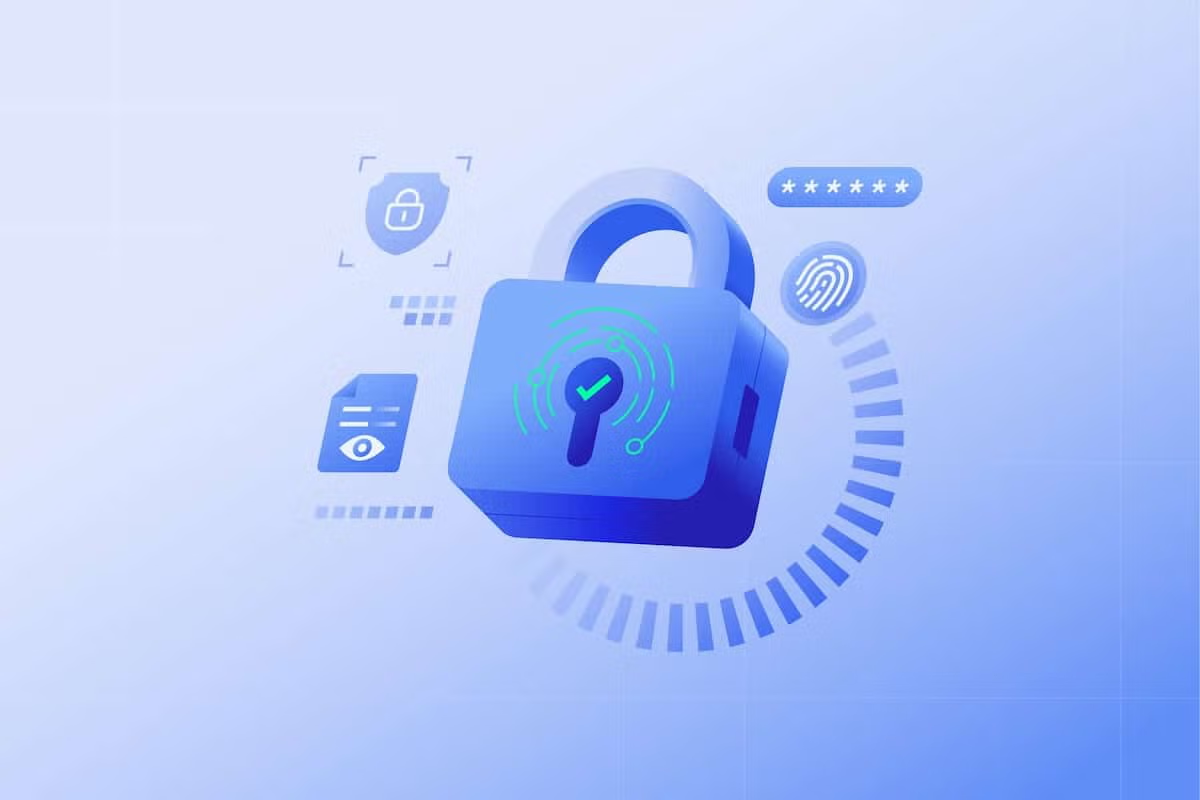
As autonomous agents move from experimental sandboxes into core enterprise production systems, securing non-deterministic software execution becomes a top priority for CISOs and technical leadership. In 2026, implementing robust AI agent governance and security frameworks is mandatory to prevent unauthorized data access, privilege escalation, and unintended system modifications across multi-agent environments.
Building enterprise-grade AI agent governance and security requires transitioning away from traditional static perimeter defense models. Because autonomous agents generate dynamic runtime code, invoke external web APIs, and modify database states independently, security teams must deploy continuous cryptographic monitoring and real-time policy enforcement engines.

To maintain enterprise compliance without stifling operational speed, organizations must adopt zero-trust agent isolation architecture. By confining agent execution threads within tightly scoped ephemeral sandboxes, security managers can prevent lateral network movement while capturing complete, tamper-proof execution logs for regulatory auditing.
Security Benchmark: Enforcing strict least-privilege IAM scoping across autonomous agent networks reduces runtime credential exposure risks by up to 68% in distributed enterprise clouds.
Core Pillars of Enterprise AI Agent Governance and Security
Unlike traditional web API integrations that process predictable inputs and outputs, dynamic agentic workflows introduce non-deterministic execution risks. Effective AI agent governance and security architectures rest on three core operational pillars:
- Least-Privilege Identity Management (Agent IAM): Every autonomous worker must be assigned an isolated service identity with strictly bounded token allowances and target namespace access.
- Cryptographic Runtime Traceability: Every model reasoning step, tool call payload, and external memory write must be signed with cryptographic hashes to build immutable audit trails.
- Real-Time Policy Evaluation Gateways: Intercept every outgoing agent action with automated security filters to detect credential leakage, malicious prompt injections, or policy violations before execution.
To explore how security policy engines integrate with frontend layouts, cloud scale centers, and multi-agent systems, review our technical guides on Enterprise UI UX for AI Agents, Autonomous AI Infrastructure in 2026, Agentic AI Workflows, and Multi-Agent AI Systems Enterprise Architecture. For official cybersecurity standards, consult the NIST AI Risk Management Framework.
Secure Your Enterprise AI Agent Fleet with Devanum
Our specialized cybersecurity architects perform full-stack runtime penetration testing and compliance audits for autonomous agent deployments.
5 Best Audit Rules for Enterprise AI Agent Governance
Establishing scalable security controls across distributed agent clusters requires continuous automated validation. Implement these five best audit rules to strengthen your AI agent governance and security posture:
- 1. Ephemeral Sandbox Execution: Run all agent code generation and external script execution inside disposable container environments that destroy persistent local state upon completion.
- 2. Outbound Network Egress Filtering: Restrict agent egress connections strictly to whitelisted domain endpoints, blocking unauthorized data exfiltration or unverified third-party API calls.
- 3. Dynamic Human-in-the-Loop Gateways: Require signed human operator authorization before agents execute high-risk operations, such as financial transactions or production database schema updates.
- 4. Immutable Log Streaming: Stream all token telemetry, prompt context windows, and tool execution logs directly into append-only compliance storage vaults.
- 5. Automated Prompt Injection Defense: Deploy real-time sanitization proxies at the model input layer to strip adversarial instruction hijacking attempts from untrusted user inputs.
Governance Best Practice: Always maintain an emergency global “Panic Revoke” trigger across your control plane to instantly freeze agent runtime tokens across all cloud environments during security anomalies.
Comparing Traditional API Security vs. AI Agent Governance
Understanding the fundamental operational differences between static microservice security and dynamic agent governance helps enterprise security leaders design resilient protection layers:
| Security Dimension | Traditional REST API Security | AI Agent Governance & Security |
|---|---|---|
| Trust Assumptions | Deterministic path validation via static tokens | Zero-Trust dynamic policy enforcement per tool call |
| Data Access Bounds | Pre-defined SQL queries and endpoint schemas | Dynamic semantic queries over vector memory stores |
| Threat Vectors | SQL injection, XSS, broken object authentication | Prompt injection, goal hijacking, credential exfiltration |
| Audit Trail Requirements | Standard HTTP access logs & status codes | Full chain-of-thought, prompt contexts, & payload hashes |

Mitigating Goal Hijacking and Adversarial Prompt Exploits
One of the most complex vulnerabilities facing dynamic autonomous networks is goal hijacking. In this attack scenario, malicious actors introduce concealed instructions into external documents (such as PDFs, emails, or web pages) processed by the agent, diverting it from its original system prompt.
To neutralize goal hijacking, modern AI agent governance and security architectures implement dual-LLM verification loops. A dedicated, lightweight “guard rail model” evaluates the primary agent’s planned actions against system policy before sending commands to external runtime tools.
Additionally, isolating data processing tasks from execution tasks ensures that agents reading untrusted external inputs cannot directly invoke administrative APIs without passing through a secondary policy evaluation layer.
Future-Proofing Compliance in Autonomous Organizations
As regulatory standards for artificial intelligence tighten globally, enterprises that invest early in verifiable audit frameworks will navigate compliance audits with minimal operational disruption. Standardizing your governance stack around open telemetry formats ensures seamless integration with modern SIEM platforms and enterprise compliance tools.

By prioritizing AI agent governance and security today, forward-thinking enterprise teams can confidently deploy high-autonomy worker fleets that accelerate business productivity while keeping enterprise assets fully protected.